how the economy works
How Does an Economy Actually Work?
A plain-English guide to how an economy works, from money and credit to inflation and growth, using real stories from Ghana, Nigeria and Kenya.
byEdison Ade · October 22, 2026 · 15 min read
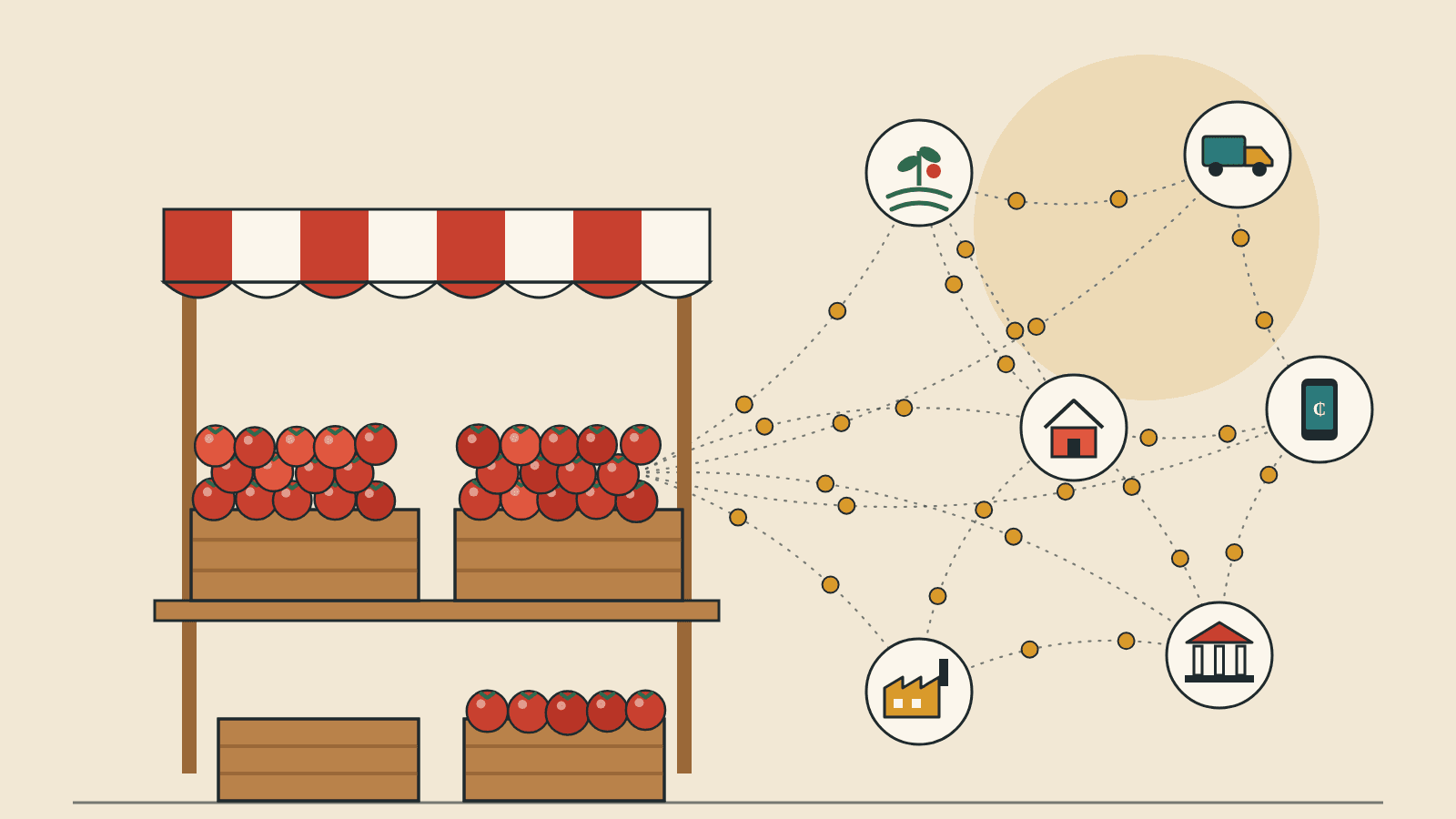
In February 2023, millions of Nigerians spent their days queueing outside banks for money that was already theirs.
The central bank had redesigned the 200, 500 and 1,000 naira notes and given people until 1 February to hand in the old ones. The new notes never arrived in enough numbers. ATMs ran dry. Point-of-sale agents charged as much as 4,000 naira to hand over 20,000 in cash, and a man in Lagos told reporters that people were "using naira to buy naira." A driver said he could not go to the market to buy food. Manufacturers watched unsold goods pile up in their warehouses.
Yet nothing real had been destroyed. The farms were still planted, the factories still had their machines, and the workers still had their skills and the same hours in the day. What Nigeria had lost, for a few weeks, was its way of keeping track of who owed what to whom, and that was enough to make a country of more than 200 million people grind to a halt.
Economists call everything that was still standing that month the real economy: the work people can do, the things they make with it, and the arrangements that let them do it for each other. Money sits on top and helps it run. To see how the two fit together, it helps to start somewhere much smaller than a nation, at a single market stall in Accra.
A crate of tomatoes
At Makola Market, a little after six, a tomato seller I'll call Esi sells two crates to a man who runs a chop bar in Adabraka. He pays in cedis. By lunchtime the tomatoes will be stew, the stew will be sold, and on Thursday he will come back for more.
That sale is the smallest working part of an economy, and almost every question economists argue about is already folded inside it. Where did the tomatoes come from? Why did they cost what they cost? What will Esi do with the money? And what would make next Thursday's crate cheaper, or dearer, than this one?
Follow one crate backwards and it fills with other people's work.
A farmer near Techiman planted and picked the tomatoes. Someone made the crate. A driver brought it down the highway overnight, in a truck built in another country, burning diesel refined in yet another. The road was laid by a construction crew Esi will never meet, and paid for with taxes collected from people she will never meet either.
The phone in her apron pocket tells the same story at a larger scale. Its parts were mined, refined, designed, assembled and shipped across four or five continents. No single person alive knows how to make one from scratch, yet one is sitting next to her tomatoes, and she uses it to tell regular customers she has fresh stock.
This is specialisation, and it is the oldest trick in economics. Each person gets good at one narrow thing and trades for the rest. Esi does not need to understand diesel engines to sell tomatoes, and the mechanic who fixes the truck does not need to know how to grow them. Because each of them can lean on everyone else's skill, all of them together can produce far more than they could alone.
The same arrangement creates dependence. A broken bridge on the Kintampo road can leave a good farmer's harvest rotting in the field. A late fuel shipment can idle a hundred trucks. When economies fail, they usually fail at a link in a chain like this one, and the trouble travels along it in both directions.
Without money, the chop bar owner would have to find a tomato seller who happened to want stew, at the moment he wanted tomatoes.
Economists call this the double coincidence of wants, and it is why barter never got far. Money removes the coincidence. Esi accepts cedis without wanting stew because she knows the driver, the farmer and her landlord will accept them from her in turn.
The best way to picture money is as a scoreboard. When you do something useful for someone else, you are given points. When you need something from someone else, you hand points over. The tomatoes, the stew and the lunch are the wealth; the cedis keep track of who has contributed and who is entitled to draw on what others produce. That system holds together on one thing only, which is confidence that the points will still be accepted tomorrow.
Kenya shows how much a better scoreboard can be worth. When M-Pesa let people send money by text message, a farmer's son working in Nairobi could support his family in Kisumu the same afternoon, and a household hit by a bad harvest could be helped by relatives several towns away. The economists Tavneet Suri and William Jack followed Kenyan households for years and estimated that access to mobile money had lifted about 2% of them out of extreme poverty, roughly 200,000 homes. Kenya's farms and workers were unchanged. What had improved was the speed and reach of the system that moves claims on their work from one person to another.
The scoreboard has one rule that explains a great deal. Every cedi spent becomes a cedi earned by someone else. The chop bar owner's spending is Esi's income. Her spending becomes the driver's income, and his becomes the mechanic's. When the chop bar owner decides to hold on to his money instead, perhaps because he has heard prices are about to jump, Esi earns less, so she spends less, so the driver earns less too.
That is how a slowdown spreads with nobody behaving foolishly. Worried households postpone purchases. Businesses lose sales and stop hiring. Workers who see their friends lose jobs grow cautious themselves. Each decision is sensible on its own, and together they deepen the hole everyone is trying to avoid.
Add up all the final spending on goods and services in a country over a year and you get gross domestic product, or GDP, the number most news about the economy is built around. It is a useful number with real blind spots. It ignores how income is shared out, so a country can grow while most households fall behind. It leaves out most unpaid work, such as caring for children and elderly parents. And it can rise on bad news: if a flood destroys a market and the city spends heavily to rebuild it, GDP goes up even though the city is poorer than it was before the water came. GDP tells you how fast the points are changing hands. To know whether people are better off, you have to look at the field.
Prices, loans and interest
Nobody tells Esi what to charge. She looks at what the crates cost her this morning, what the seller two stalls down is asking, and how many customers have walked past without stopping. Prices carry information that no planner could gather. When tomatoes are scarce, the price rises, and that rise tells farmers to plant more and tells chop bars to make lighter stew. When there is a glut, the price falls and the messages reverse.
Nigeria watched this happen in 2016, when a moth called Tuta absoluta, nicknamed "tomato Ebola" by farmers, tore through the crop in the north. Kaduna State declared a state of emergency, and a wholesale basket of tomatoes climbed to around 42,000 naira. No government ordered anyone to eat fewer tomatoes. The price did it, telling every cook in Lagos to stretch the stew and every farmer with healthy plants to get them to market fast.
Those messages take time to act on, since a farmer cannot grow tomatoes in a week. Prices also reflect power as well as scarcity. A supplier with no competitors can charge more than one with five rivals, and a family with an urgent need and no money cannot make the market notice them at all.
Now suppose the chop bar is doing well and its owner wants a second freezer he cannot afford. He goes to a bank. Most people imagine the bank lends him money that other customers have deposited, but the Bank of England explained in 2014 that the process mostly runs the other way. When a commercial bank approves a loan, it writes a new deposit into the borrower's account, and most of the money in a modern economy is created this way. What holds banks back is the central bank's interest rate, the rules they must follow, and their own judgement about who will pay them back.
A loan lets someone spend money they have not yet earned, so it raises spending today. The freezer shop gets a sale, the electrician gets a job, and the chop bar can serve more customers. For the next two years, though, a slice of its income goes back to the bank instead of into tomatoes or wages. A loan that pays for a freezer earning more than it costs leaves the owner better off. One that pays for things he cannot afford can sink a good business.
The price of all this borrowing is the interest rate, and above every bank in Ghana sits the Bank of Ghana, setting the policy rate the others lean on. Raise it, and loans get dearer, people borrow and spend less, and the economy cools. Lower it, and the reverse happens, slowly, like an old building's heating responding to a turned dial.
The main reason anyone turns the dial is inflation, a general rise in prices that means each cedi buys less. It happens when spending grows faster than the supply of things to buy, when a harvest fails or a port jams, or when imported goods get dearer. It feeds on itself when people expect it: a landlord who thinks prices will rise 30% next year raises the rent now. Higher interest rates can cool spending, but they cannot unjam a port or grow tomatoes, so a central bank always has to ask where the pressure is coming from before deciding how hard to push.
New money also lands unevenly. Whoever receives it first, usually banks, governments and people who already own property or shares, gets to spend it before prices adjust. Those who receive it last, typically wage earners and traders like Esi, find that prices have already moved by the time it reaches them.
Ghana adds one more complication. The country buys a great deal from abroad, including fuel, medicine, machinery, rice and, in some seasons, tomatoes from Burkina Faso, all priced in dollars. When the cedi weakens, all of it costs more in cedis even though nothing about the goods has changed. Exporters of cocoa or gold may gain from the same fall, while the importers and the families who buy from them lose. For a country that imports this much, the exchange rate is a second inflation dial, and nobody in Accra fully controls it.
Nigeria showed how fast that dial can turn. In June 2023 the government ended its costly petrol subsidy and loosened controls on the naira, which then lost more than 40% of its value. Both decisions had long-term logic behind them, since the subsidy was draining the budget and the controlled exchange rate was starving businesses of dollars. In the short run, though, fuel, transport and imported food all got dearer at once. By March 2024 inflation had reached 33.2%, the highest in 28 years, and food inflation was above 40%. A Lagos family spending most of its income on food felt every point of it.
When the score stops adding up
Governments take part in every link of this chain. They write the rules for contracts, food safety and wages. They build roads, run schools and pay nurses, things no tomato seller could arrange on her own. They collect taxes, and when taxes fall short, they borrow. Borrowing that builds a road used for forty years can pay for itself many times over. Borrowing that covers today's bills leaves a debt with nothing to show for it.
Ghana's debts came due in 2022. Public debt had already reached 79.6% of GDP in 2021. Then the rest of the world turned against borrowers. American interest rates rose, investors pulled money out of riskier countries, and the cedi lost about half its value against the dollar over the year. Because much of Ghana's debt was owed in dollars, the currency's fall alone added around $6 billion to what the country owed. By late 2022, more than half of government revenue was going on debt payments.
Everything described above then happened at once. Imports became far more expensive in cedis, so fuel, transport and food prices jumped, and inflation reached 54.1% in December 2022. The Bank of Ghana raised interest rates sharply to slow it, which made credit painfully expensive for the very businesses trying to stay open. The government raised VAT and froze public hiring. In December it agreed a $3 billion programme with the IMF and asked local bondholders to swap their bonds for ones worth less. On 19 December, it suspended payments on most of its foreign debt.
Esi never read about any of this in a budget statement. She saw a crate that cost more every time she restocked, and customers who bought one crate where they used to buy two. The chop bar owner gave up on his freezer. The driver paid more for diesel and passed it on. Each of them made a sensible choice, and their choices added up to a recession.
The recovery was slow and costly, and it worked. By January 2026 inflation had fallen to 3.8% after thirteen straight monthly declines, and the cedi had gained about 40% against the dollar over the previous year, its first annual rise in decades. In September 2026 the Bank of Ghana held its policy rate at 14%, about half its level in early 2025, with inflation running near 5%. The country paid heavily for borrowing against its future, and it came through with a clearer sense of the arithmetic.
Kenya ran into the same arithmetic from a different direction. Years of borrowing had left the government spending a huge share of its revenue on interest, and in 2024 it tried to close the gap with a Finance Bill meant to raise about $2.3 billion in new taxes. Young Kenyans organised against it online and then in the streets. On 25 June, the day parliament passed the bill, protesters broke into the building and set part of it on fire, and the Kenya National Commission on Human Rights said at least 22 people were killed. The next day President William Ruto withdrew the bill. The debt stayed. By the end of 2024, Kenya was spending about 61% of the tax it collected on debt payments, money that could otherwise have paid for clinics, roads and teachers.
The two stories teach the same lesson. A government's debt is ultimately paid by its citizens, through higher taxes, higher prices or fewer services, and when people feel the bill arriving without having seen what it bought, the economics quickly becomes politics.
The slow force underneath
Credit, interest rates and exchange rates explain why an economy lurches from boom to bust over a few years. They explain very little about why one country ends up ten times richer than another over fifty. That gap comes from productivity, meaning how much a person can produce with an hour of work.
Go back to the road from Techiman. A large share of the tomatoes picked there spoil before anyone buys them, bruised in the truck or ripened too fast in the heat. The farmer works as hard for the ones that rot as for the ones that sell. Give that chain cold storage, sturdier crates and trucks that leave on a schedule, and the same farm with the same people feeds more of Accra. Nobody has borrowed anything or printed anything, and the country is richer, because the same work now produces more.
Nigeria's numbers make the point sharper. By one estimate reported during the 2016 crisis, about 75% of the country's tomato harvest is lost, mostly to poor storage and transport. Imagine recovering even a third of that. Nigeria would gain an enormous amount of food without planting a single extra seed, and the farmers who grew it would finally be paid for all of their work.
Every lasting rise in living standards has come this way: better tools, healthier and better-trained workers, reliable power, honest institutions, and competition that rewards whoever finds a better method. Debt and policy can speed that up or slow it down for a while. Over a lifetime, productivity sets the ceiling.
Whether people actually live better also depends on who gets the gains. A country can double its output while most families see little of it. So a fair test of any economy is how far its gains spread.
This is where a founder can do the most good. A business that helps a trader restock in an hour instead of a day, or lets a pharmacy see which medicines are about to run out, raises what a working person can get done. Spread that across a market and it shows up, eventually, in the national accounts and in household budgets.
Closing time
By evening, Esi has sold most of her stock. Somewhere in Accra a central banker is studying last month's prices, a finance ministry official is redrafting next year's borrowing plan, and a currency trader in London is deciding what the cedi is worth tonight. Each of their choices will reach her stall sooner or later, as a dearer crate, a cheaper loan, or a customer who comes back for a second one.
She counts her cedis, sets aside what she owes the driver, and decides how many crates to order for the morning. That small decision rests on a larger question, the same one every household, business and government in the country is asking in its own way: can she trust tomorrow enough to prepare for it?
An economy works when enough people can answer yes.

Written by Edison Ade
I help founders build companies that can think, sell and move without waiting on them.
About EdisonOne idea every Thursday.
Master the System: weekly insights on strategy, systems and growth.