
Understanding How Arrogance and Entitlement Hinder Continuous Progress

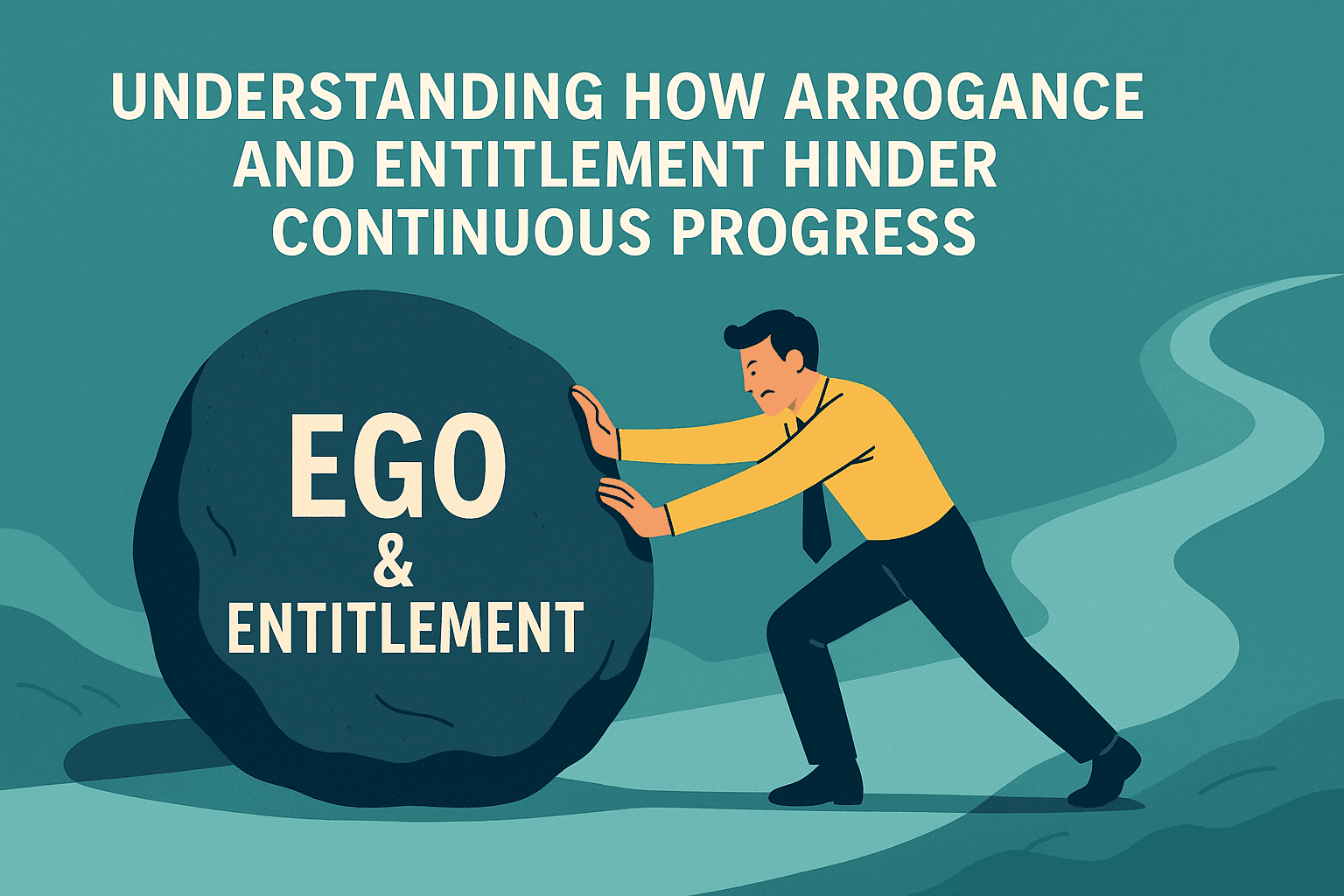
The enemy of progress is not always a lack of talent but the belief that you’ve already arrived.
Most of us like the idea of progress. We post quotes about growth, set ambitious goals, and celebrate when we hit a new milestone. Yet, if we are honest, there are seasons when the graph flattens out, when yesterday’s breakthrough becomes today’s plateau.
We blame market conditions, team turnover, or the list of books we have not had time to read. Rarely do we stop to ask what role arrogance and entitlement play in slowing the climb.
Arrogance is the inner voice that whispers, “You have already figured this out.” It is not confidence; confidence says, “I can learn.” Arrogance says, “I already know.” Once that belief settles in, curiosity shrinks.
Questions feel like threats, feedback feels like insults, and the messy experimentation that fuels real advancement starts to look unnecessary.
The arrogant manager who once ran customer interviews every quarter decides she has “heard enough.” The developer who shipped an award-winning feature stops reviewing pull requests with the same rigor. The result is predictable: yesterday’s insight becomes today’s fossil, and the outside world quietly moves on.
Arrogance hides behind past wins.
It convinces you that what worked before will always work again. That because you’ve mastered one level, you’re automatically ready for the next. That feedback is beneath you. That learning is optional.
But growth doesn’t come from standing on your past. It comes from building forward—humbly.
History is littered with once-greats who lost because they stopped listening.
What arrogance looks like:
- Interrupting when someone is sharing insights.
- Shrugging off mentors.
- Assuming you’re “too senior” to be challenged.
Entitlement on the other hand is the belief that you deserve the prize without enduring the process.
You think just because you showed up, the world owes you a standing ovation. You think your degree, your network, your past hustle, automatically guarantee your future rewards. This is a trap I wallowed in for many years.
Entitlement says:
- “Why didn’t I get the promotion?”
- “This opportunity should’ve been mine.”
- “I’ve already proven myself.”
It’s a seductive mindset because it feels like self-worth. But it’s actually stagnation disguised as confidence.
The market doesn’t care about what you did. It rewards what you’re doing, right now, consistently.
Arrogance, at its core, stems from an inflated sense of self-importance and a belief that one's knowledge, skills, or achievements inherently surpass those of others. When arrogance creeps in, it silently sabotages progress by creating blind spots. Individuals become so convinced of their superiority that they dismiss constructive criticism and ignore vital feedback. This rejection of external insights means they inevitably repeat mistakes, stagnate in outdated practices, and lose opportunities for meaningful growth.
Consider the story of once-thriving companies that collapsed because leadership refused to acknowledge industry shifts or listen to market signals. Blackberry’s dominance faded quickly due to an unwillingness to adapt and the arrogance of thinking their existing technology was unbeatable. Arrogance blinds people and organizations alike to emerging opportunities and threats, ultimately leading to their downfall.
The truth is, genuine progress requires something that both arrogance and entitlement actively resist: the willingness to be wrong, to start over, and to acknowledge that we don't have all the answers. When we understand how these mindsets operate, we begin to see why so many promising individuals and organizations plateau just when they should be accelerating.
Arrogance whispers a seductive lie—that our current knowledge and abilities are sufficient for whatever challenges lie ahead. This false confidence feels empowering at first, but it quickly becomes a cage. The arrogant mind stops asking questions because it believes it already knows the answers. It stops seeking feedback because criticism feels like an attack on its identity rather than information that could fuel improvement.
Consider what happens when an experienced manager encounters a problem that doesn't fit their usual solutions. Instead of exploring new approaches or consulting with others, arrogance pushes them to force-fit old methods onto new challenges. They double down on familiar strategies, even when evidence suggests a different path might work better.
This defensive stance spreads beyond individual decision-making. Teams led by arrogant individuals learn to keep their ideas to themselves, knowing that alternative viewpoints will be met with resistance or dismissal. Innovation requires the collision of different perspectives, but arrogance creates an echo chamber where only familiar ideas can survive. Progress slows, then stops, while everyone involved believes they're still moving forward.
Entitlement operates through a different mechanism but arrives at the same destination. Where arrogance says "I already know enough," entitlement declares "I shouldn't have to work this hard." This mindset fundamentally misunderstands the nature of meaningful progress, expecting advancement to come without the struggle that actually creates it.
The entitled mind becomes frustrated with the natural pace of growth. It wants the promotion before mastering the current role, the recognition before delivering exceptional value, the respect before demonstrating competence.
This impatience leads to shortcuts that ultimately undermine the very progress being sought. Skills remain underdeveloped, relationships become transactional, and sustainable success remains elusive.
What They Both Rob You Of
- Self-awareness. You stop seeing your weaknesses and overplay your strengths.
- Curiosity. You stop asking, “What am I missing?”
- Drive. You lose the hunger that got you started in the first place.
- Collaboration. People stop challenging you. They stop engaging. They nod and walk away.
⠀
But there is good news
Both mindsets are optional. They are habits of thought, not fixed traits, and habits can be replaced. The first move is to re-anchor identity in process rather than position. Instead of declaring, “I am the person who closed the biggest deal,” shift the narrative to, “I am the person who studies closing techniques every Friday afternoon.” When identity is tied to repeatable behaviors, growth becomes self-reinforcing.
Each small experiment, reflection, or coaching session is another vote for the person you are becoming.
Next, build systemic feedback that cannot be ignored. Arrogance thrives when praise is louder than evidence, and entitlement thrives when tenure is louder than results.
Create dashboards that report uncomfortable truths. Institute peer reviews where the newest hire can challenge the most senior architect. Schedule “pre-mortems” that assume a project will fail and then work backward to find the cracks. These rituals do not guarantee humility, but they make denial expensive.
Another antidote is to embed time in the calendar for what scientists call “productive failure.” Set aside a week each quarter where the explicit goal is to test an unproven idea and document what breaks. When the organization expects and even celebrates small flops, the ego stops treating mistakes as verdicts on personal worth and starts treating them as tuition. Arrogance loosens its grip because the culture rewards learning speed more than being right the first time. Entitlement fades because rewards are tied to fresh contribution, not past laurels.
You can also audit your reactions. Do you feel defensive when challenged? That’s the first sign.
⠀
Let’s bring this home
Arrogance tells you you're above learning.
Entitlement tells you you’ve earned the outcome.
But progress belongs to the relentlessly teachable, the ones who stay sharp, stay humble, and show up every day like they still have something to prove.
Because they do.
Authored by Edison Ade
I show founders how to use AI and better systems to grow faster, save time, and build something that lasts.
Full StoryMaster the System.
Weekly insights on AI strategy, growth frameworks, and business architecture.