
Why Your Brain Sabotages the Life You Dream Of

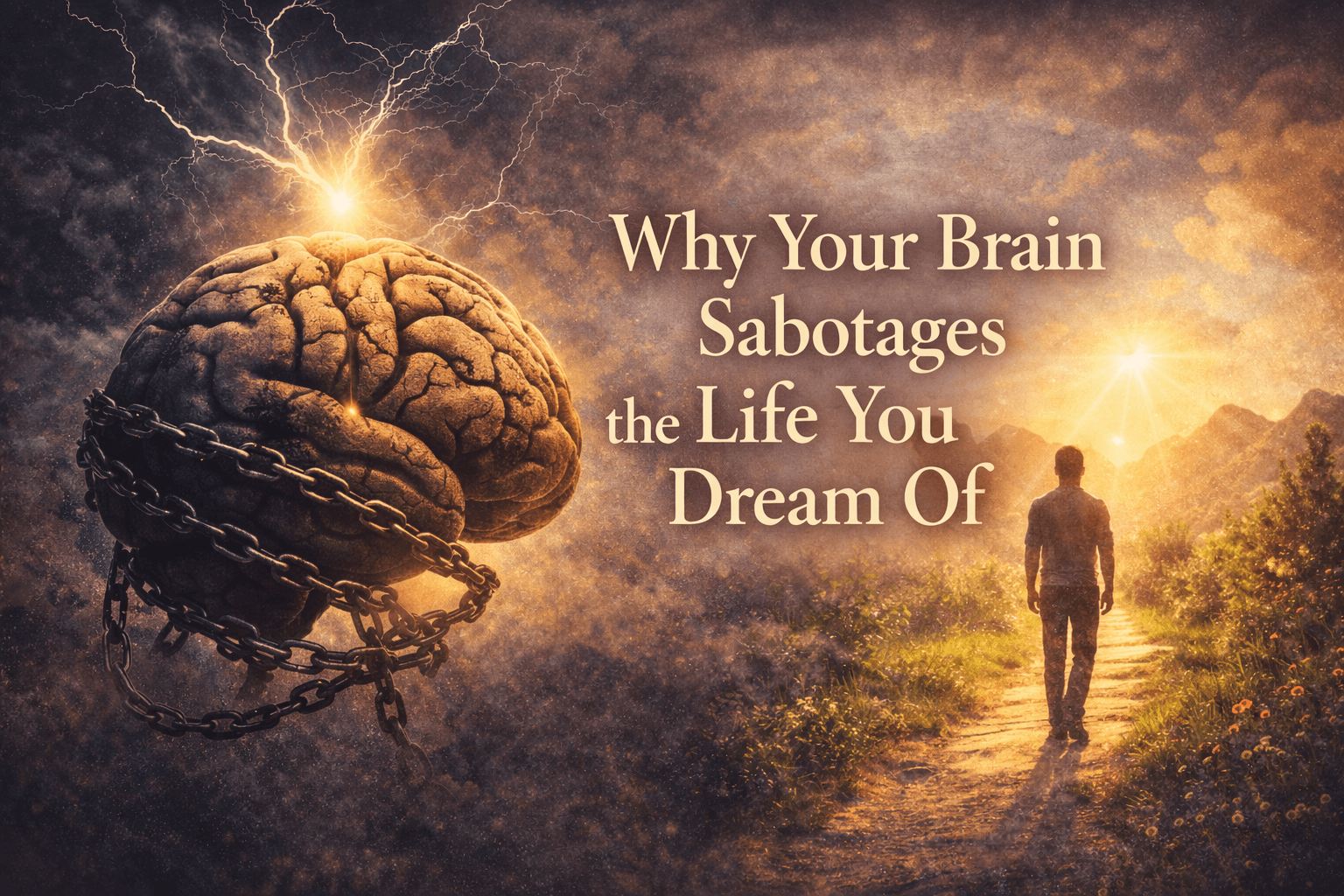
Before the full light, we rise as fervent believers, silently conspiring against the very grain of our being. With the break of day, we strike a bargain:
Today, I will say what I mean. Today, I will not yield to the old, cold anger.
Today, the version of me that lives in the margins will finally step into the center.
But the day is long, and gravity is heavy. By the time the sun sets, we have retreated into the comfortable, worn grooves of the self we know, soothed by the easy lullabies of rationalization that our minds supply on demand.
The great human tragedy is not that we fail to become who we want to be; it is that we fiercely protect the very person we are trying to outgrow.
Your brain is a biological conservator, a three-pound universe obsessed with the preservation of the status quo. It does not crave your evolution; it craves homeostasis. It views your desire for transformation with the same suspicion a body views a virus. Even when your current life feels like a garment that chafes the skin, even when the scent of possibility is intoxicating, your brain will construct elaborate barricades to keep you stationary. It is not acting out of malice. It is acting out of a terrified fidelity to your survival.
We labour under the delusion that we are fluid, that we are rivers bending toward the sea of experience. But the psychological reality is far more rigid.
We are not water; we are concrete. The stories we have told ourselves about who we are—our competence, our unworthiness, our limitations—harden into a lens that filters out every contradictory ray of light. We do not see the world as it is; we see ourselves as we are, projected onto the world.
This is not a failure of willpower. You can force the body through the motions of discipline, rising at dawn, running the miles, swallowing the silence, but these are merely cosmetic renovations on a crumbling foundation.
As the researcher Maja Djikic noted,
"Who we believe we are is often the enemy of who we want to become."
The identity is a fortress; it is designed to withstand the siege of change.
Consider the executive who has built her cathedral on the belief that she is "the fixer," or the parent who has armored himself in the identity of the "anxious guardian." These are not habits to be broken; they are theological convictions. To change them would require a kind of psychological apostasy. It would require the dismantling of the altar.
The trap into which the earnest constantly fall:
We believe that if we look deep enough into our own eyes, we will find the exit. So we journal. We meditate. We walk the labyrinth of our own minds in the dead of night, looking for a thread that leads out.
But the mind cannot be trusted to oversee its own demolition. Asking your brain to reimagine your identity is like asking a dictator to pen his own resignation. The machinery of the ego kicks in, flooding the consciousness with the reasonable, the logical, the safe. *Not yet. Not now. You are not ready.* The solitude of self-reflection is often just an echo chamber where the past whispers to the future.
This is why true transformation is a social act, or it is nothing. You cannot escape the gravitational pull of your own perception without an external force. You need a witness.
The only way to see the watermark on your own life is to hold it up to the light of another human being.
A coach, a therapist, a true friend—someone who holds a mirror that you cannot tilt or angle to your liking. In the presence of an other, the lies lose their oxygen. The "yes, buts" that guard the gate begin to wither.
You need someone to ask the question your mind has strategically forbidden. You need to hear the unexamined excuses tumble out of your mouth and realize, in the harsh light of the air, that they are just sounds, just noise, just stories.
To choose this path requires courage that feels perilously close to madness.
You must be willing to walk out onto the wire without a net. You must abandon the map you were given, risking the censure of those who liked you better when you were predictable. You will feel like an impostor in your own skin.
But neuroscience offers a cold comfort: the brain’s stubbornness is matched only by its plasticity. It is never too late to pave a new neural road. The same flexibility that allowed you to learn language as a child lies dormant in the adult cortex, waiting for the spark of a new narrative.
Phoebe Eng wrote that
"taking risks is the process of peeling back the layers of what you are, to be who you want to be."
Beneath those layers, there is no solid core, no immutable stone. There is only a process, a constant, shifting, becoming.
The question is not if you will change. You are changing already, eroding and reforming with every passing moment. The question is whether you will stand at the helm of that change, or let the currents of your own biology drift you back into the harbor of the familiar.
Your brain will fight you.
It will offer you safety in exchange for your stagnation.
But you know better now. The cage was never locked.
The door was never barred. It was only the story you told yourself about your own captivity that kept you from turning the handle.
Authored by Edison Ade
I show founders how to use AI and better systems to grow faster, save time, and build something that lasts.
Full StoryMaster the System.
Weekly insights on AI strategy, growth frameworks, and business architecture.